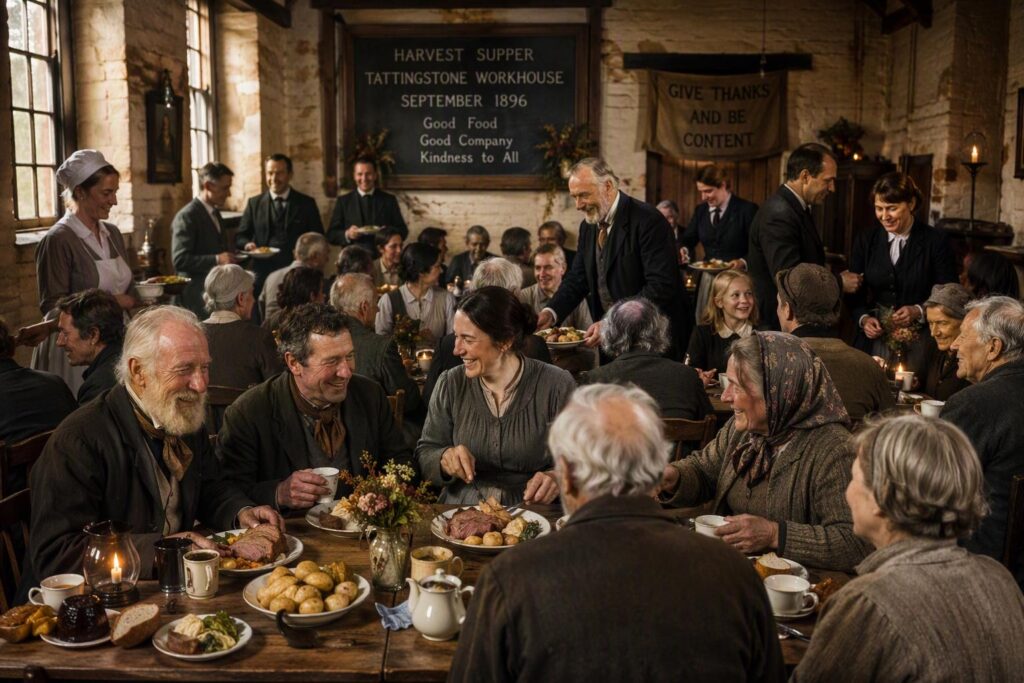
When people think of the Victorian workhouse, they often picture hardship, hunger and strict discipline. While these realities certainly formed part of workhouse life, they do not tell the whole story. Occasionally, the historical record reveals moments that offer a different perspective, small acts of kindness and community that stood out against the routine of institutional living.
One such occasion took place at Tattingstone Workhouse in September 1896.
As the harvest season drew to a close and the surrounding fields were cleared, anticipation began to spread among the inmates. A harvest supper had been arranged, an event that broke the monotony of daily life and provided something rare, an evening designed for enjoyment rather than necessity.
Preparations began days beforehand. The usual routines of cleaning, cooking and work continued, but there was a noticeable sense of expectation within the workhouse. News of the forthcoming supper circulated among the residents, bringing a welcome distraction from the normal order of the institution.
On the evening of the event, the dining hall was prepared with unusual care. Long tables were laid out neatly, and the smell of a substantial meal drifted from the kitchens. Instead of the plain fare usually associated with workhouse diets, the inmates were treated to roast beef, followed by plum pudding and tea.
The meal itself was generous by workhouse standards. Additional treats were also distributed. Men received tobacco, women were given sugar, and residents described in contemporary records as “imbeciles” were presented with sweets. These simple gifts may appear modest today, but they were clearly intended as tokens of celebration and consideration.
The atmosphere in the dining hall gradually changed as the evening progressed. Conversation became louder and more relaxed. People who otherwise lived under constant regulation found an opportunity to socialise more freely. Visitors from the parish, including the Reverend, took part in serving the meal and speaking with residents, helping to create a sense of shared participation rather than distant supervision.
Once supper had ended, the tables were rearranged and entertainment followed. Readings, music and recitations provided amusement for those gathered. There was nothing extravagant about the programme, yet it offered something increasingly valuable within institutional life, the chance to enjoy an evening together.
For a few hours, the workhouse felt different. The regulations and routines that governed daily existence remained in place, but they loosened enough to allow genuine moments of enjoyment. Laughter, conversation and companionship briefly replaced the formality normally associated with workhouse life.
By the next morning, the ordinary routine resumed. The dining hall was restored to its usual appearance and the special evening became a memory. Yet events such as this demonstrate an important point for historians.
The history of the workhouse is complex. It contains stories of poverty, loss and institutional discipline, but it also contains examples of compassion, celebration and community. Harvest suppers, Christmas dinners and other special occasions provided opportunities for inmates to experience moments of dignity and inclusion within a system that often denied them both.
The harvest supper at Tattingstone in September 1896 may not have transformed anyone’s circumstances, but it reminds us that even within one of Victorian Britain’s most criticised institutions, human kindness could still find a place. For those fortunate enough to attend, it was almost certainly an evening long remembered.