Caution: This story contains material that some readers may find distressing.
Among the records held at the Archives are documents that reveal the stories of ordinary families whose lives rarely appear in history books. One such file concerns six-month-old William Edward Hillcock of Felixstowe and a tragedy that unfolded in the winter of 1916.
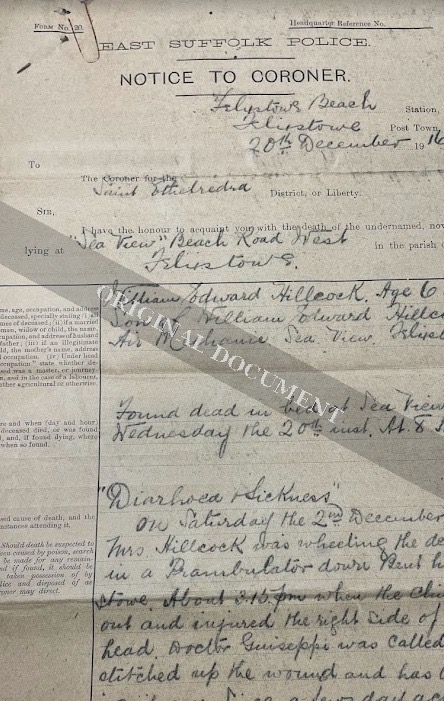
The story begins with a police notice sent to the coroner on 20 December 1916. The document reported the death of William Edward Hillcock, the infant son of William Edward Hillcock, an air mechanic, and his wife Charlotte Ethel Hillcock. The family lived at Sea View on Beach Road West in Felixstowe.
At first glance, the circumstances seemed straightforward. The police report stated that William had been found dead at approximately 8 a.m. that morning and suggested the cause of death was “diarrhoea sickness”, a common term used at the time for severe gastrointestinal illness in infants.
However, as further documents reveal, the story was more complicated.
Just over two weeks earlier, on 2 December 1916, Charlotte Hillcock had been wheeling her son in his pram down Bent Hill in Felixstowe when he accidentally fell out, injuring his forehead. The child was treated by Dr Paul Leon Giuseppi, who stitched the wound and continued to monitor his condition.
The accident naturally raised concerns when the baby later died. Had the injury contributed to his death?
The surviving correspondence shows that the coroner sought clarification. In a note sent shortly before the inquest, the police informed the coroner that Dr Giuseppi could not connect the pram accident with the child’s death. Medical evidence suggested the head injury was not responsible.
An inquest was held at Felixstowe on 23 December 1916 before Coroner Walter Brooke.
Witness statements preserved in the file provide a glimpse into the family’s final days with their son.
Dr John Laurence Johnson testified that he had been called on the day of William’s death but found the child already dead upon arrival. He confirmed that the infant had suffered a fall from his pram earlier in the month and noted that sickness and diarrhoea had developed shortly before death.
Dr Giuseppi also gave evidence. He recalled treating the forehead wound following the accident and described William as a strong, healthy child before his final illness. He too stated that sickness and diarrhoea had appeared in the days leading up to the child’s death.
The most moving testimony came from William’s mother, Charlotte.
She explained that her son had become restless during the night of 19-20 December. Concerned for his comfort, she took him from his pram and placed him in bed with her. She checked on him during the night and believed he was well. When she awoke at around 8 a.m., she discovered that he had died.
The medical evidence led Dr Giuseppi to offer a different conclusion from the one originally recorded by the police. In his opinion, William’s death was caused by suffocation after being accidentally overlaid.
In the language of the time, “overlaying” referred to the accidental suffocation of an infant while sharing a bed with an adult. Such deaths were sadly not uncommon in the early twentieth century, particularly among families caring for sick children during cold winter nights.
The jury returned its verdict on 23 December 1916:
“Death from suffocation from being accidentally overlaid whilst in bed with his parents.”
More than a century later, these documents remind us that family tragedies were recorded not only in parish registers and death certificates, but also in the detailed statements collected by coroners. Through the testimony of doctors, police officers and grieving parents, the records allow us to reconstruct a small but deeply human story from Suffolk’s past.
For William Edward Hillcock, whose life lasted only six months, the archive preserves the final chapter of a life that might otherwise have been forgotten.