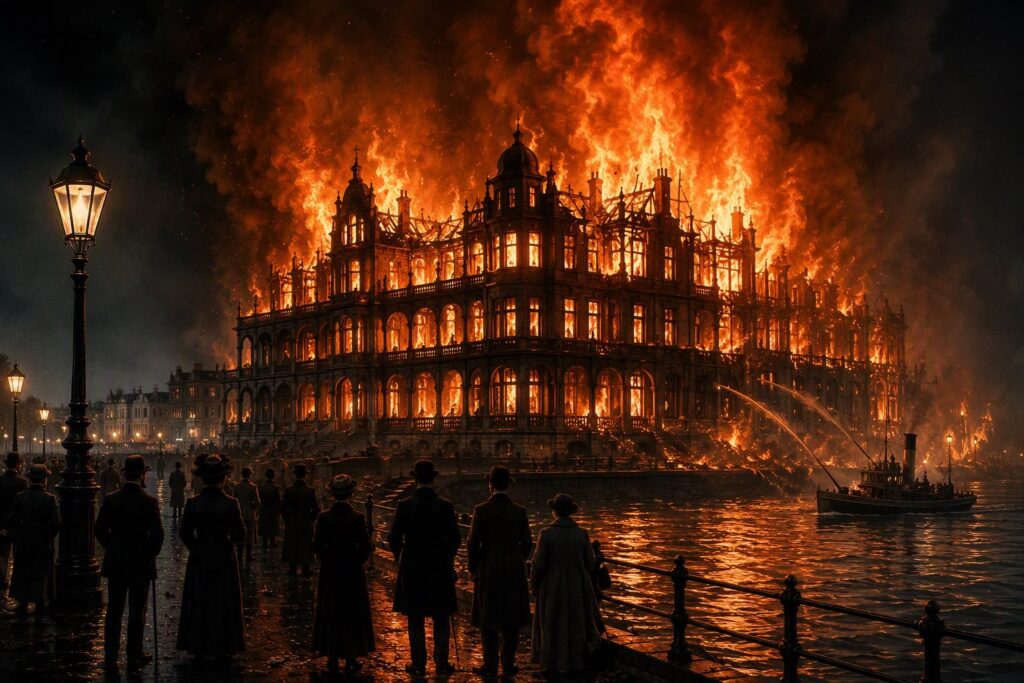
In the early hours of 28 April 1914, one of Felixstowe’s most recognisable landmarks was reduced to a smoking ruin. The Bath Hotel, a grand Victorian building overlooking the seafront, became the target of a militant suffragette attack that shocked Suffolk and attracted national attention.
Today, more than a century later, the destruction of the Bath Hotel remains one of the most dramatic episodes in the county’s history, a story that highlights both the determination of the women’s suffrage movement and the growing tensions that existed in Britain on the eve of the First World War.
Felixstowe’s Grand Seaside Hotel
At the beginning of the twentieth century, Felixstowe was developing into one of East Anglia’s most fashionable seaside resorts. Visitors were drawn to its promenade, gardens, and impressive hotels. Among the most prominent was the Bath Hotel, which occupied a commanding position along the seafront.
The building was a symbol of Edwardian prosperity and leisure. For residents and visitors alike, it represented the confidence of a growing resort town. Yet, in 1914, it would become the focus of a political protest that demonstrated just how far some activists were willing to go in their fight for women’s voting rights.
The Suffragette Campaign Turns Militant
By 1914, the campaign for women’s suffrage had been running for decades. While many organisations continued to pursue constitutional methods, the Women’s Social and Political Union (WSPU), led by Emmeline Pankhurst, had adopted increasingly militant tactics.
Frustrated by the repeated failure of Parliament to grant votes to women, some suffragettes began targeting property. Across Britain, campaigners damaged golf courses, cut telegraph wires, attacked artworks, and carried out arson attacks against buildings. Their aim was to create publicity and force politicians to confront the issue.
The WSPU often described its approach as “deeds not words”, believing that direct action would achieve what years of petitions and peaceful protest had failed to accomplish.
Hilda Burkitt and Florence Tunks
The attack on the Bath Hotel was carried out by two suffragettes, Evaline Hilda Burkitt and Florence Tunks.
Hilda Burkitt was already a well-known militant activist within the movement. She had been arrested on several occasions and had endured force-feeding during hunger strikes in prison. For many suffragettes, imprisonment became a battleground in itself. Hunger strikes were used to protest against being treated as ordinary criminals rather than political prisoners.
Florence Tunks was also an active member of the movement and worked alongside Burkitt in carrying out militant actions.
Both women were deeply committed to the cause and willing to risk imprisonment for their beliefs.
The Fire at the Bath Hotel
During the night of 28 April 1914, Burkitt and Tunks made their way to the Bath Hotel carrying materials used to start the fire. The building was unoccupied at the time, a common feature of suffragette arson campaigns, as the intention was generally to damage property rather than cause loss of life.
Once the blaze took hold, it spread rapidly through the large wooden structure. Flames soon engulfed the building, lighting up the night sky and drawing crowds of shocked spectators. Reports described a spectacular scene as the fire raged along the seafront.
Despite the efforts of firefighters, the Bath Hotel could not be saved. The damage was estimated at around £40,000, a vast sum at the time. The destruction of such a prominent landmark made headlines across the country and became one of the most significant suffragette arson attacks in Britain.
Arrest and Trial
The investigation quickly led authorities to Burkitt and Tunks. The two women were arrested at Felixstowe railway station soon after the attack.
Their trial took place at the Bury St Edmunds Assizes and attracted considerable public interest. For supporters of the suffrage movement, the case highlighted the sacrifices women were making in pursuit of political equality. For critics, it demonstrated the dangers of militant activism.
Both women were convicted and sentenced to imprisonment.
As on previous occasions, imprisonment did not end the protest. Hunger strikes followed, continuing the struggle behind prison walls. Burkitt’s experiences of force-feeding reflected the harsh treatment many militant suffragettes faced during this period.
A Landmark Lost Forever
Unlike many historic buildings damaged by fire, the Bath Hotel was never rebuilt.
Its loss permanently altered part of Felixstowe’s seafront and left a lasting memory within the town. For local residents, the destruction was both a dramatic event and a reminder that national political conflicts could reach even seemingly peaceful seaside communities.
The fire remains one of the most significant events linking Suffolk to the wider suffrage movement.
Remembering the Event Today
The burning of the Bath Hotel is sometimes viewed through two very different lenses. To some contemporaries, Burkitt and Tunks were criminals who destroyed a valuable local landmark. To others, they were political activists driven to extreme measures after years of frustration and exclusion from the democratic process.
Whatever view is taken, there is no denying the significance of the event. The fire at Felixstowe formed part of the final militant phase of the suffrage campaign. Just a few months later, the outbreak of the First World War transformed British society and effectively brought much of the suffragette campaign to a halt.
Women over the age of thirty eventually gained the parliamentary vote in 1918, with equal voting rights with men following in 1928.
The ruins of the Bath Hotel have long since disappeared, but the story of that night in April 1914 remains an important chapter in Suffolk’s history. It is a reminder of the passions, divisions, and sacrifices that accompanied the struggle for women’s suffrage, and of how a quiet Suffolk seaside town briefly found itself at the centre of a national political battle.