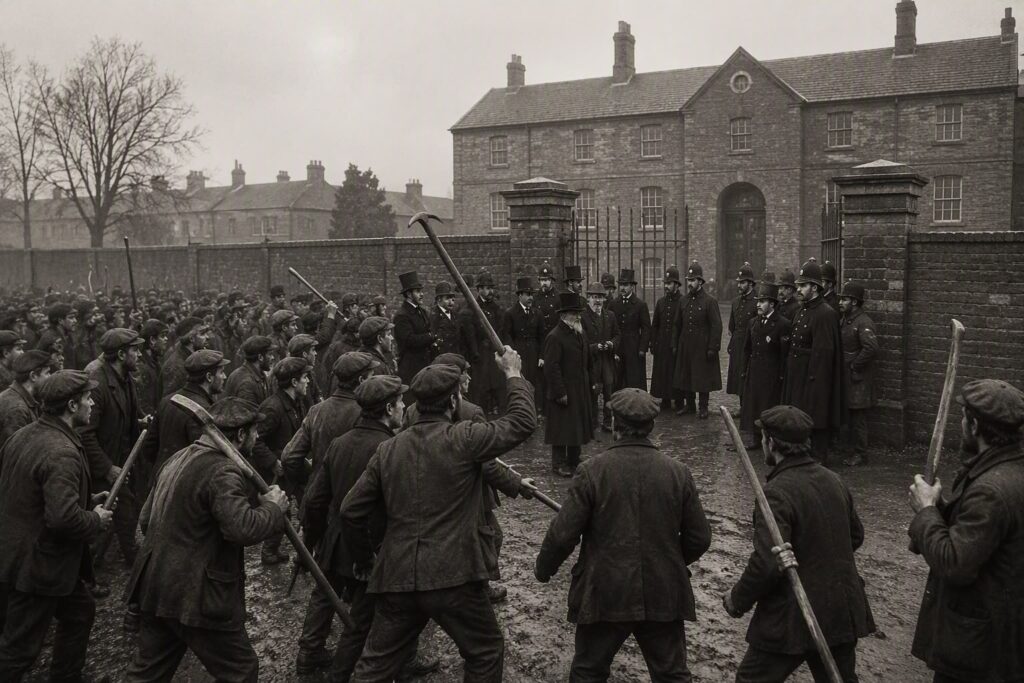
On a winter afternoon in December 1835, a Suffolk workhouse found itself at the centre of a dramatic confrontation that reflected a growing national crisis.
Just one year earlier, the Poor Law Amendment Act of 1834 had transformed the way relief was provided to the poor. For centuries, individual parishes had offered support to those unable to support themselves through a mixture of money, food, clothing and housing. The new legislation swept much of that system away.
Under the new arrangements, parishes were grouped into Poor Law Unions and administered by Boards of Guardians. Most controversially, the government insisted that relief should increasingly be provided through the workhouse. Conditions within these institutions were deliberately made difficult. Policymakers believed that life inside the workhouse should be less desirable than life outside it, even for the lowest-paid labourer. The aim was to discourage reliance on poor relief and reduce costs to ratepayers.
For many working people, however, the New Poor Law represented something far more frightening. Families could be separated. Elderly people who had previously received support in their own homes often faced the prospect of entering the workhouse. Agricultural labourers, already struggling with low wages and uncertain employment, viewed the new system with suspicion and anger.
It was against this backdrop that events unfolded on 21 December 1835.
Reports reached the local Board of Guardians that a large body of men, armed with pickaxes, crowbars and other tools, were advancing towards Blything Union workhouse
from several directions. Fears quickly spread that an organised attack was imminent.
The Guardians reacted immediately. A messenger was sent to Colonel Bence, and emergency appeals for assistance were dispatched throughout the surrounding area. Local authorities scrambled to gather as many constables as possible to defend the building.
Help soon arrived. A wagon came from Wangford carrying volunteers ready to be sworn in as Special Constables. More constables travelled from Halesworth, while local gentlemen and officials joined the growing defence force. Together they prepared for the possibility of violence.
Not every community responded in the same way. Contemporary accounts expressed frustration that Southwold refused to send assistance despite repeated requests. In the eyes of the Guardians, neighbouring towns were rallying to protect the workhouse while Southwold stood aside.
As the afternoon progressed, tensions intensified.
At around two o’clock, a crowd estimated at 200 people was seen approaching the workhouse from the direction of Halesworth. The Guardians, accompanied by local magistrates, Colonel Bence, the Reverend Anthony Collett and Thomas Wood, went to meet them at the gates.
The authorities attempted to reason with the crowd, hoping to prevent the situation from escalating. Yet persuasion achieved little. Faced with what they saw as a serious threat to public order, the magistrates took the significant step of having the Riot Act read aloud by Reverend Collett.
The reading of the Riot Act was not a casual measure. It was a formal warning that those gathered could be treated as an unlawful assembly and face prosecution if they failed to disperse.
After lengthy discussions, the crowd finally withdrew. The immediate danger had passed.
Yet the protesters left with a final warning: they threatened to return in even greater numbers on another occasion.
Although no attack ultimately took place, the incident offers a powerful glimpse into the hostility that greeted the New Poor Law in its earliest years. The workhouse was not simply a building. To many labouring families, it symbolised a loss of local control, the fear of family separation and uncertainty about the future. The fact that hundreds were willing to march on a workhouse only a year after the legislation was introduced demonstrates the depth of feeling it provoked.
Nearly two centuries later, this forgotten Suffolk confrontation reminds us that the Poor Law was never merely an administrative reform. For ordinary people, it touched every aspect of daily life and could provoke resistance strong enough to bring hundreds to the workhouse gates.