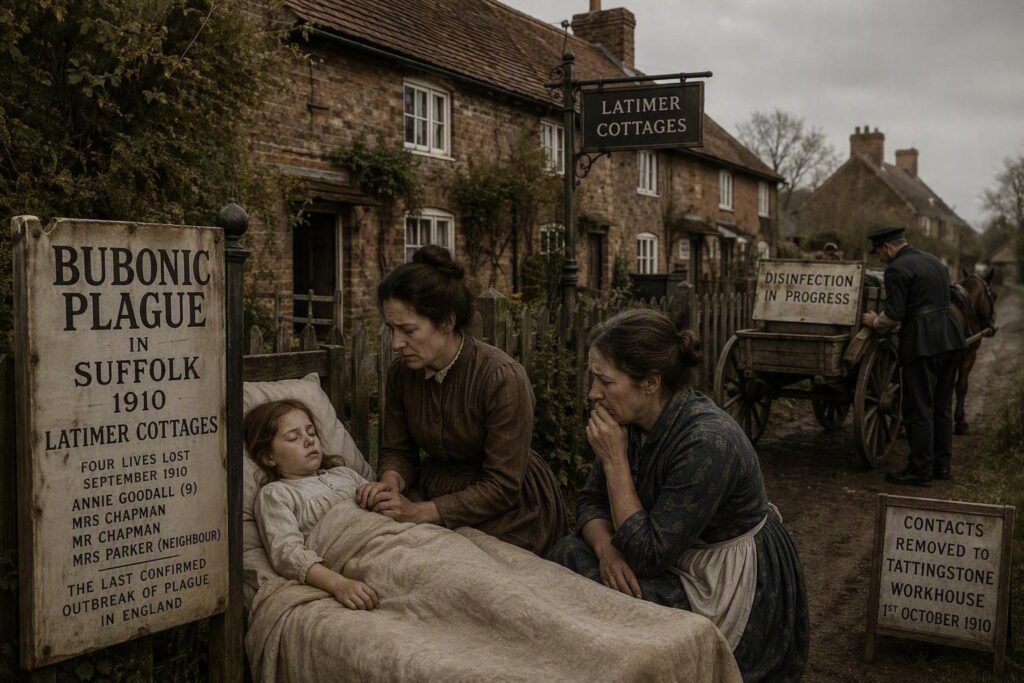
In September 1910, life at Latimer Cottages, a small row of homes standing between Freston and Holbrook in rural Suffolk, appeared entirely ordinary. The cottages overlooked fields and farmland, and the families who lived there followed a familiar routine of work, school, and domestic life. Within a matter of weeks, however, these cottages would become the centre of an event that would secure a place in medical history, the last confirmed outbreak of plague in England.
The outbreak began with nine-year-old Annie Goodall, who lived in the middle cottage with her mother, stepfather Mr Chapman, and her siblings. On 13 September 1910, Annie suddenly became ill. Her symptoms started with vomiting and a high fever. Concerned by her condition, the family called for Dr Carey, the local doctor.
When Dr Carey examined Annie the following day, there was little to indicate the true nature of her illness beyond her severe temperature. Yet her condition deteriorated rapidly. She became increasingly weak, drifted in and out of consciousness, and developed a persistent cough. Despite the efforts made to care for her, Annie died on 16 September, only three days after her first symptoms appeared.
At the time, neither her family nor the medical authorities realised that her death marked the beginning of something far more serious. Later bacteriological testing would confirm that Annie had become the first victim of plague.
Annie’s funeral took place on 20 September 1910. Records from her school note that older pupils attended the burial, demonstrating the impact her death had on the close-knit rural community. In a village where families knew one another well, the loss of a child was deeply felt.
Tragically, the family had little time to mourn. On the morning after Annie’s funeral, her mother began to show similar symptoms. She suffered headaches, nausea, breathing difficulties, and gastrointestinal complaints. As concern grew, Dr Herbert Brown travelled from Ipswich to assist Dr Carey in treating the increasingly alarming cases. Their efforts proved unsuccessful. Mrs Chapman died on 23 September.
The disease continued to spread among those who had been in close contact with the household. Mr Chapman, despite feeling unwell, attempted to continue working. Meanwhile, Mrs Parker, a neighbour who had nursed Annie’s mother during her illness, also became sick. Both developed severe symptoms and died on 29 September 1910.
By this stage, local doctors recognised that they were dealing with something unusual. Determined to identify the cause, Dr Carey collected samples which were examined by Dr Llewellyn Heath in Ipswich. Heath successfully isolated the plague bacillus, providing the first indication of what had happened. To ensure complete certainty, the findings were forwarded to Professor Sims Woodhead in Cambridge, one of Britain’s leading bacteriologists. His confirmation removed any remaining doubt. The disease responsible for the deaths at Latimer Cottages was plague.
For many people today, plague belongs to the distant past, associated with medieval Europe and the Black Death. Yet plague had never entirely disappeared. Small outbreaks continued to occur in various parts of the world, and during the early twentieth century a number of cases were recorded around Britain’s eastern coast.
Investigators soon turned their attention to the source of the infection. Their enquiries pointed towards rats carrying infected fleas. It was believed that the disease had arrived through maritime trade, with infected rodents travelling on ships moving through the Orwell and Stour estuaries. Suffolk and neighbouring Essex had already experienced isolated plague incidents during the period between 1906 and 1918, making this explanation the most likely.
Once the diagnosis was confirmed, authorities acted swiftly to prevent further spread. Individuals who had been in contact with the victims were placed under observation and isolation at Tattingstone Workhouse from 1 October. Those attending the burials on 30 September had their clothing disinfected as a precautionary measure.
Despite understandable fears within the community, these measures proved effective. No additional cases occurred in the village, and the outbreak was successfully contained.
For the people living around Freston and Holbrook, the events of September 1910 must have seemed both frightening and bewildering. Within just a few weeks, four lives had been lost, including a young child whose illness had appeared at first to be nothing more than a severe fever. Only afterwards did medical science reveal the extraordinary truth.
Today, the story of Annie Goodall and the residents of Latimer Cottages remains one of the most remarkable episodes in Suffolk’s history. It serves as a reminder that even in the twentieth century, diseases often associated with an earlier age could still emerge unexpectedly. More than a century later, the outbreak is remembered not simply as a medical curiosity, but as a human tragedy that left a lasting mark on the local community and became recognised as the final confirmed outbreak of plague in England.