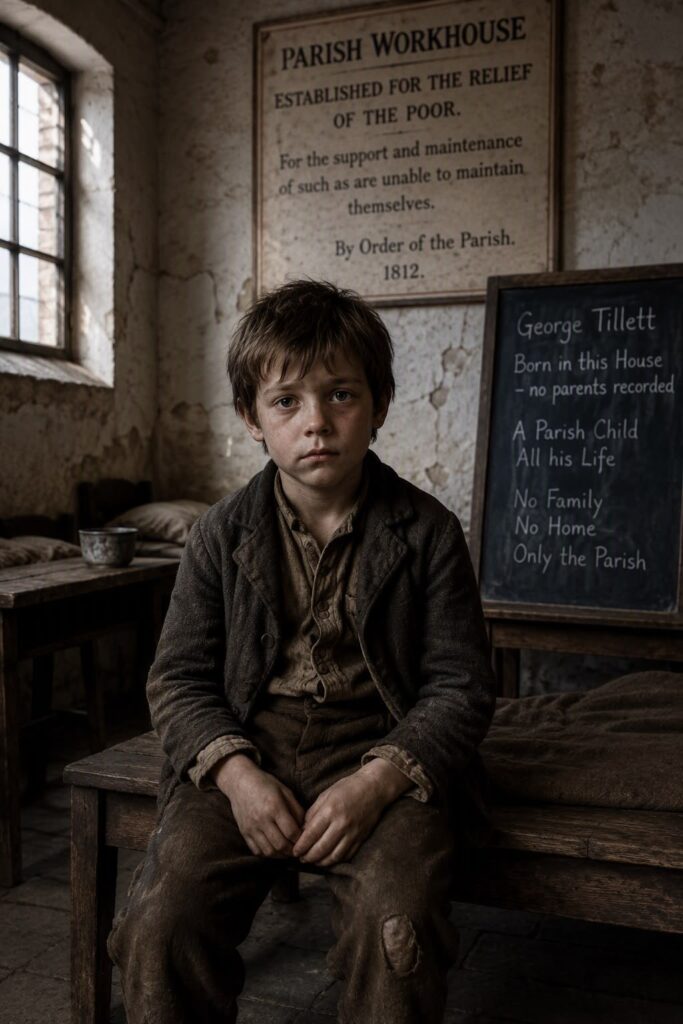
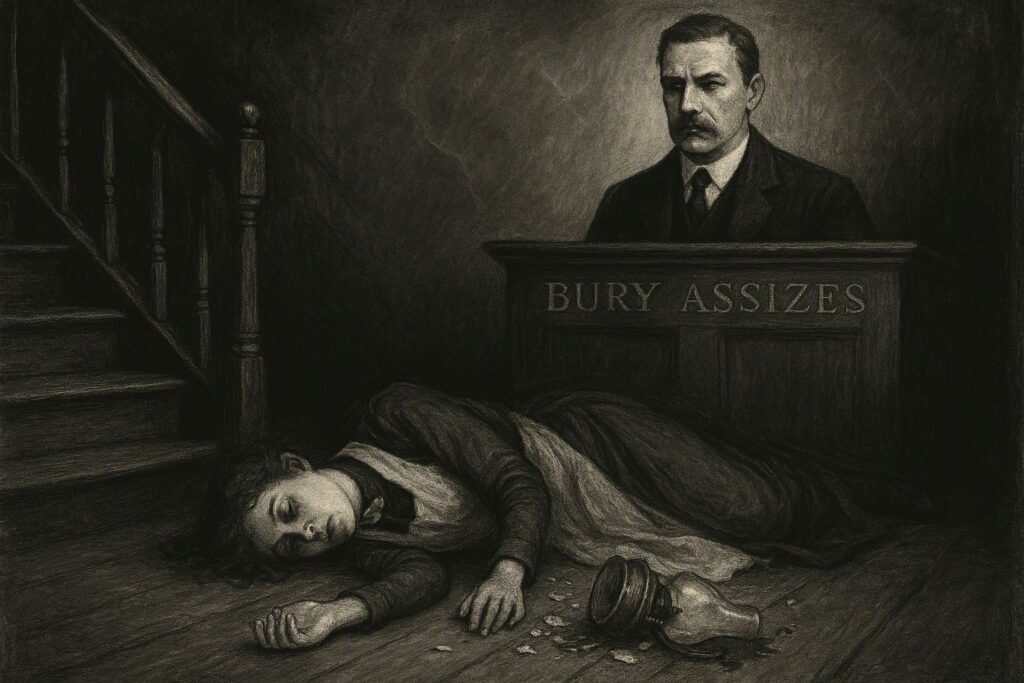
George Tillett’s story is one of the many forgotten lives hidden within Suffolk’s poor relief records. Unlike many children who entered parish care for a short period, George appears to have spent much of his life dependent upon the parish, with little evidence of family support beyond the authorities responsible for his upkeep.
The surviving records tell a story marked by absence. Before George appears in the records, his older brother Samuel had already come under parish care. No father is recorded, and the surviving documents provide little information about their mother. Whatever circumstances brought the family to this point, the result was that two young boys became dependent upon the parish for support.
Before 1834, responsibility for relieving the poor rested with individual parishes. Children without parental support could be maintained at parish expense, placed with local families, apprenticed, or accommodated in parish poorhouses where such facilities existed. For many children, life depended on the willingness and resources of the parish to provide even the most basic necessities.
George grew up within this system. The records reveal a child whose life was closely tied to parish support, a reminder of how precarious life could be for those born into poverty. While some children eventually left parish care through apprenticeship or employment, others remained dependent upon relief for much longer.
When George died, his passing was recorded in the same parish records that had documented his life. Few details survive, and like so many of Suffolk’s poor, he left little trace beyond the official entries made by parish officers.
Today, George Tillett’s story reminds us of the many children whose lives were shaped by the Old Poor Law. Their experiences rarely appear in traditional histories, yet they formed an important part of Suffolk’s past. By recovering stories like George’s, we gain a better understanding of the realities faced by the county’s poorest families and the children who depended upon parish support for survival.
Do you ever look at a road or place name and wonder where it comes from?
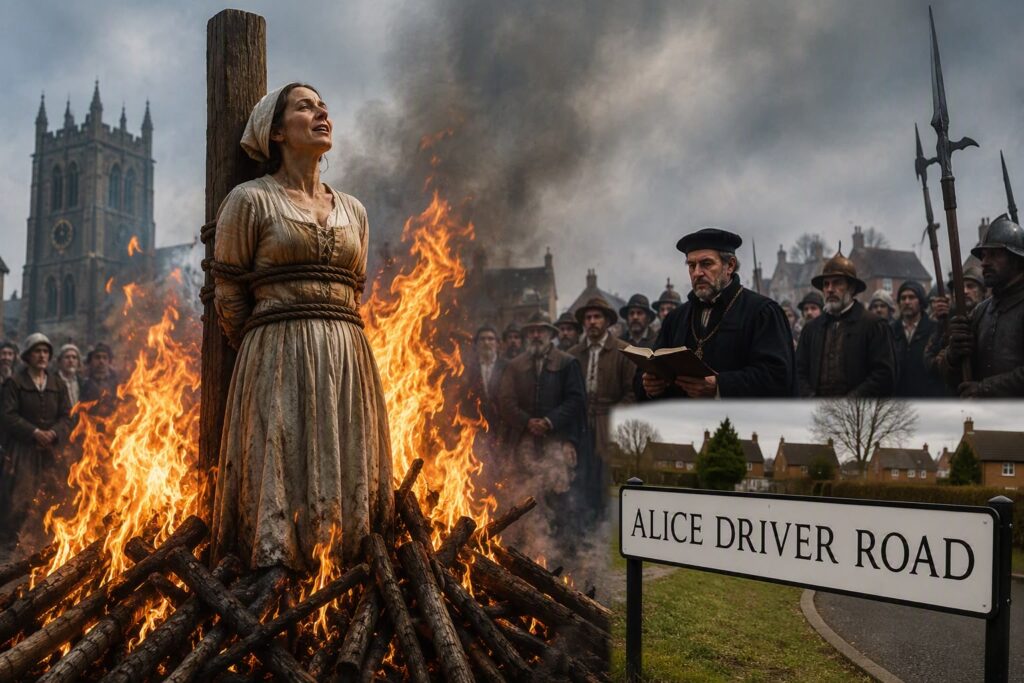
Alice Driver Road in Grundisburgh is a great example.
Most people pass the sign without giving it a second thought, yet it commemorates one of Suffolk’s best-known Protestant martyrs, a woman whose courage in the face of persecution secured her place in history.
Alice Driver lived in Grundisburgh during the reign of Queen Mary I. A married woman and mother, she became associated with the Protestant faith at a time when Mary was attempting to restore Roman Catholicism in England. Those who refused to conform could face imprisonment, punishment, and even death.
In 1558, Alice was arrested after helping Alexander Gooch, a Protestant weaver from Woodbridge who was hiding from the authorities. The pair were discovered concealed in a haystack near Grundisburgh and were taken into custody.
Alice quickly gained a reputation for her confidence and determination. During her examinations by church officials, she refused to abandon her beliefs. When she compared Queen Mary to the biblical Jezebel, Sir Clement Heigham ordered that her ears be cut off as punishment. Despite this brutal treatment, Alice remained steadfast.
Later, while being questioned in Ipswich by Dr Spenser, Chancellor of Norwich, Alice continued to challenge her examiners. Contemporary accounts describe her as fearless, outspoken, and unwilling to be intimidated by those in authority.
On 4 November 1558, Alice Driver and Alexander Gooch were burned at the stake on Ipswich Cornhill for heresy. Alice was around thirty years old. Her execution was one of the final acts of the Marian persecutions, coming just ten days before Queen Mary’s death on 17 November 1558.
With the accession of Elizabeth I, England returned to Protestantism and the burnings came to an end. However, the memory of Alice Driver endured.
Today, she is remembered among the Ipswich Martyrs, and her name lives on in the village where her story began. Alice Driver Road is more than just a modern street name, it is a reminder of an ordinary Suffolk woman whose courage ensured that she would not be forgotten.
The next time you pass the sign, take a moment to remember the remarkable woman behind the name.
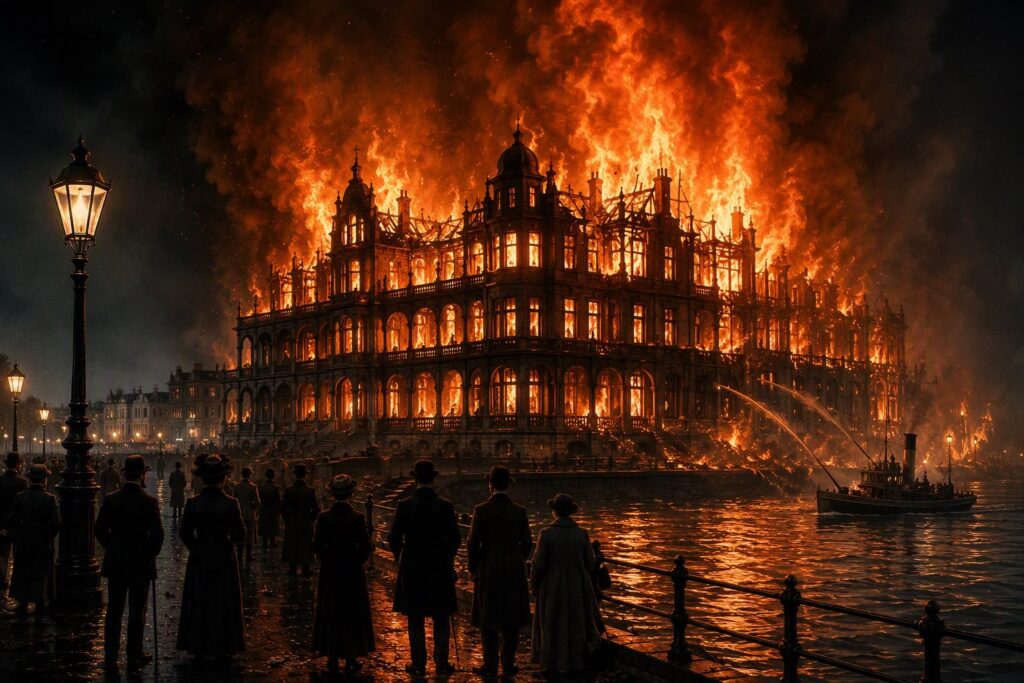
In the early hours of 28 April 1914, one of Felixstowe’s most recognisable landmarks was reduced to a smoking ruin. The Bath Hotel, a grand Victorian building overlooking the seafront, became the target of a militant suffragette attack that shocked Suffolk and attracted national attention.
Today, more than a century later, the destruction of the Bath Hotel remains one of the most dramatic episodes in the county’s history, a story that highlights both the determination of the women’s suffrage movement and the growing tensions that existed in Britain on the eve of the First World War.
Felixstowe’s Grand Seaside Hotel
At the beginning of the twentieth century, Felixstowe was developing into one of East Anglia’s most fashionable seaside resorts. Visitors were drawn to its promenade, gardens, and impressive hotels. Among the most prominent was the Bath Hotel, which occupied a commanding position along the seafront.
The building was a symbol of Edwardian prosperity and leisure. For residents and visitors alike, it represented the confidence of a growing resort town. Yet, in 1914, it would become the focus of a political protest that demonstrated just how far some activists were willing to go in their fight for women’s voting rights.
The Suffragette Campaign Turns Militant
By 1914, the campaign for women’s suffrage had been running for decades. While many organisations continued to pursue constitutional methods, the Women’s Social and Political Union (WSPU), led by Emmeline Pankhurst, had adopted increasingly militant tactics.
Frustrated by the repeated failure of Parliament to grant votes to women, some suffragettes began targeting property. Across Britain, campaigners damaged golf courses, cut telegraph wires, attacked artworks, and carried out arson attacks against buildings. Their aim was to create publicity and force politicians to confront the issue.
The WSPU often described its approach as “deeds not words”, believing that direct action would achieve what years of petitions and peaceful protest had failed to accomplish.
Hilda Burkitt and Florence Tunks
The attack on the Bath Hotel was carried out by two suffragettes, Evaline Hilda Burkitt and Florence Tunks.
Hilda Burkitt was already a well-known militant activist within the movement. She had been arrested on several occasions and had endured force-feeding during hunger strikes in prison. For many suffragettes, imprisonment became a battleground in itself. Hunger strikes were used to protest against being treated as ordinary criminals rather than political prisoners.
Florence Tunks was also an active member of the movement and worked alongside Burkitt in carrying out militant actions.
Both women were deeply committed to the cause and willing to risk imprisonment for their beliefs.
The Fire at the Bath Hotel
During the night of 28 April 1914, Burkitt and Tunks made their way to the Bath Hotel carrying materials used to start the fire. The building was unoccupied at the time, a common feature of suffragette arson campaigns, as the intention was generally to damage property rather than cause loss of life.
Once the blaze took hold, it spread rapidly through the large wooden structure. Flames soon engulfed the building, lighting up the night sky and drawing crowds of shocked spectators. Reports described a spectacular scene as the fire raged along the seafront.
Despite the efforts of firefighters, the Bath Hotel could not be saved. The damage was estimated at around £40,000, a vast sum at the time. The destruction of such a prominent landmark made headlines across the country and became one of the most significant suffragette arson attacks in Britain.
Arrest and Trial
The investigation quickly led authorities to Burkitt and Tunks. The two women were arrested at Felixstowe railway station soon after the attack.
Their trial took place at the Bury St Edmunds Assizes and attracted considerable public interest. For supporters of the suffrage movement, the case highlighted the sacrifices women were making in pursuit of political equality. For critics, it demonstrated the dangers of militant activism.
Both women were convicted and sentenced to imprisonment.
As on previous occasions, imprisonment did not end the protest. Hunger strikes followed, continuing the struggle behind prison walls. Burkitt’s experiences of force-feeding reflected the harsh treatment many militant suffragettes faced during this period.
A Landmark Lost Forever
Unlike many historic buildings damaged by fire, the Bath Hotel was never rebuilt.
Its loss permanently altered part of Felixstowe’s seafront and left a lasting memory within the town. For local residents, the destruction was both a dramatic event and a reminder that national political conflicts could reach even seemingly peaceful seaside communities.
The fire remains one of the most significant events linking Suffolk to the wider suffrage movement.
Remembering the Event Today
The burning of the Bath Hotel is sometimes viewed through two very different lenses. To some contemporaries, Burkitt and Tunks were criminals who destroyed a valuable local landmark. To others, they were political activists driven to extreme measures after years of frustration and exclusion from the democratic process.
Whatever view is taken, there is no denying the significance of the event. The fire at Felixstowe formed part of the final militant phase of the suffrage campaign. Just a few months later, the outbreak of the First World War transformed British society and effectively brought much of the suffragette campaign to a halt.
Women over the age of thirty eventually gained the parliamentary vote in 1918, with equal voting rights with men following in 1928.
The ruins of the Bath Hotel have long since disappeared, but the story of that night in April 1914 remains an important chapter in Suffolk’s history. It is a reminder of the passions, divisions, and sacrifices that accompanied the struggle for women’s suffrage, and of how a quiet Suffolk seaside town briefly found itself at the centre of a national political battle.
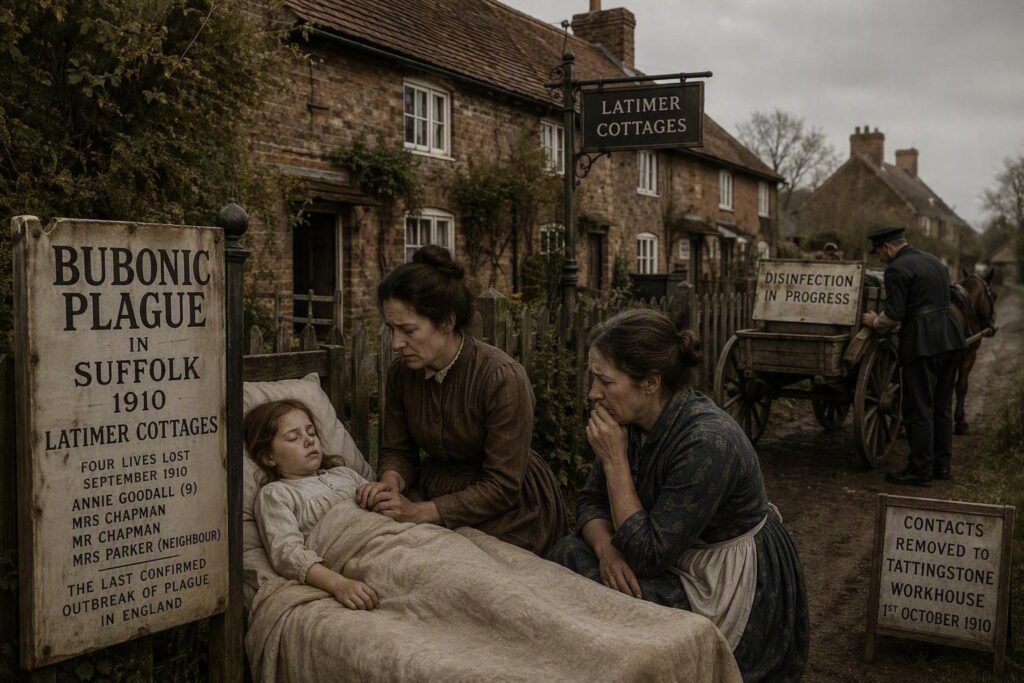
In September 1910, life at Latimer Cottages, a small row of homes standing between Freston and Holbrook in rural Suffolk, appeared entirely ordinary. The cottages overlooked fields and farmland, and the families who lived there followed a familiar routine of work, school, and domestic life. Within a matter of weeks, however, these cottages would become the centre of an event that would secure a place in medical history, the last confirmed outbreak of plague in England.
The outbreak began with nine-year-old Annie Goodall, who lived in the middle cottage with her mother, stepfather Mr Chapman, and her siblings. On 13 September 1910, Annie suddenly became ill. Her symptoms started with vomiting and a high fever. Concerned by her condition, the family called for Dr Carey, the local doctor.
When Dr Carey examined Annie the following day, there was little to indicate the true nature of her illness beyond her severe temperature. Yet her condition deteriorated rapidly. She became increasingly weak, drifted in and out of consciousness, and developed a persistent cough. Despite the efforts made to care for her, Annie died on 16 September, only three days after her first symptoms appeared.
At the time, neither her family nor the medical authorities realised that her death marked the beginning of something far more serious. Later bacteriological testing would confirm that Annie had become the first victim of plague.
Annie’s funeral took place on 20 September 1910. Records from her school note that older pupils attended the burial, demonstrating the impact her death had on the close-knit rural community. In a village where families knew one another well, the loss of a child was deeply felt.
Tragically, the family had little time to mourn. On the morning after Annie’s funeral, her mother began to show similar symptoms. She suffered headaches, nausea, breathing difficulties, and gastrointestinal complaints. As concern grew, Dr Herbert Brown travelled from Ipswich to assist Dr Carey in treating the increasingly alarming cases. Their efforts proved unsuccessful. Mrs Chapman died on 23 September.
The disease continued to spread among those who had been in close contact with the household. Mr Chapman, despite feeling unwell, attempted to continue working. Meanwhile, Mrs Parker, a neighbour who had nursed Annie’s mother during her illness, also became sick. Both developed severe symptoms and died on 29 September 1910.
By this stage, local doctors recognised that they were dealing with something unusual. Determined to identify the cause, Dr Carey collected samples which were examined by Dr Llewellyn Heath in Ipswich. Heath successfully isolated the plague bacillus, providing the first indication of what had happened. To ensure complete certainty, the findings were forwarded to Professor Sims Woodhead in Cambridge, one of Britain’s leading bacteriologists. His confirmation removed any remaining doubt. The disease responsible for the deaths at Latimer Cottages was plague.
For many people today, plague belongs to the distant past, associated with medieval Europe and the Black Death. Yet plague had never entirely disappeared. Small outbreaks continued to occur in various parts of the world, and during the early twentieth century a number of cases were recorded around Britain’s eastern coast.
Investigators soon turned their attention to the source of the infection. Their enquiries pointed towards rats carrying infected fleas. It was believed that the disease had arrived through maritime trade, with infected rodents travelling on ships moving through the Orwell and Stour estuaries. Suffolk and neighbouring Essex had already experienced isolated plague incidents during the period between 1906 and 1918, making this explanation the most likely.
Once the diagnosis was confirmed, authorities acted swiftly to prevent further spread. Individuals who had been in contact with the victims were placed under observation and isolation at Tattingstone Workhouse from 1 October. Those attending the burials on 30 September had their clothing disinfected as a precautionary measure.
Despite understandable fears within the community, these measures proved effective. No additional cases occurred in the village, and the outbreak was successfully contained.
For the people living around Freston and Holbrook, the events of September 1910 must have seemed both frightening and bewildering. Within just a few weeks, four lives had been lost, including a young child whose illness had appeared at first to be nothing more than a severe fever. Only afterwards did medical science reveal the extraordinary truth.
Today, the story of Annie Goodall and the residents of Latimer Cottages remains one of the most remarkable episodes in Suffolk’s history. It serves as a reminder that even in the twentieth century, diseases often associated with an earlier age could still emerge unexpectedly. More than a century later, the outbreak is remembered not simply as a medical curiosity, but as a human tragedy that left a lasting mark on the local community and became recognised as the final confirmed outbreak of plague in England.
WARNING: Please note that some of the content of this story can be upsetting.
In March 1914, a routine walk along a railway line near Felixstowe led to a deeply unsettling discovery. A railway worker came across a small parcel lying beside the tracks. On closer inspection, he was faced with the tragic sight of a newborn baby boy, carefully wrapped and abandoned.
Police were called immediately, and the infant was taken away for examination. The baby had been wrapped in layers of paper and cloth, and among them was a newspaper dated several weeks earlier. Written across it was a simple phrase: “God save the King.” It was a small but significant detail—one that would soon lead investigators closer to the truth.
A Crucial Clue
As news of the discovery spread through the local community, a woman came forward with an important memory. She recognised the wording written on the newspaper, recalling that her nephew had scribbled the same phrase on a paper not long before. The newspaper had passed through several hands within the family before eventually reaching a household where a young woman, Bessie Abbott, had been living as a lodger.
That single recollection provided police with the link they needed.
Suspicion and Questions
People in the household began to reflect on recent events. In the days leading up to the discovery, Bessie had appeared unwell and withdrawn. She had gone to bed early one evening, been restless through the night, and continued to behave unusually the following day.
Soon after, bloodstained laundry was found—something that raised quiet but unavoidable concern. Though initially unspoken, these observations would soon become central to the investigation.
A Confession
When approached by police, Bessie admitted that she was the baby’s mother. She explained that she had given birth alone and that the child had not survived long after delivery.
She was a young working woman with little support, and the child’s father had already left when he learned of her situation. Faced with fear, isolation, and limited options, she had been forced to handle everything by herself.
The Court’s Decision
Although the case was initially treated as a possible murder, there was not enough evidence to support that charge. Instead, Bessie was found guilty of failing to report the birth and not seeking medical assistance.
She was sentenced to a term of hard labour. While the punishment was serious, it also reflected some understanding of the difficult circumstances she had faced.
Life After Tragedy
What followed makes this story all the more remarkable.
Rather than leaving the area, Bessie remained. In time, she married and began to build a new life. Over the years, she raised a large family and created a stable home, something that must once have seemed unimaginable.
She lived a long life, reaching old age surrounded by the family she had built.
A Story of Its Time
Bessie Abbott’s story is a powerful reminder of the realities faced by many women in the early 20th century. Unmarried mothers often lived under intense social pressure, with little support and few choices.
While this story begins with tragedy, it does not end there. It is also a story of survival, resilience, and the possibility of rebuilding a life, even after the most difficult of circumstances. Previously told in Family Tree Magazine 2025
In the early hours of 1 June 1902, during a violent summer storm, a young servant’s life ended in a quiet Suffolk village, leaving behind a mystery that has never been resolved.
Peasenhall is usually a peaceful place, but that night Providence House became the scene of a brutal killing. Rose Harsant, a twenty two year old domestic servant, was found dead at the foot of the stairs. Her throat had been cut, and broken glass from a paraffin lamp lay around her. Outside, thunder and heavy rain drowned out any sound that might have raised alarm.
Attention quickly turned to William Gardiner, a local foreman and prominent member of the Primitive Methodist chapel. Although known for his respectability, there had been talk in the village of a relationship between him and Rose. A letter found near the body, said to be from Gardiner, appeared to arrange a late night meeting. At the inquest, it was revealed that Rose was around six months pregnant. The prosecution claimed Gardiner had acted to protect his position and reputation.
The case went to trial twice at the Bury St Edmunds Assizes. Each time, the evidence remained uncertain. A footprint, a missing knife, and witness accounts raised suspicion, but nothing directly linked Gardiner to the murder. Both juries failed to agree. Eventually, the Crown abandoned the case, and Gardiner was released.
Rose was buried in Peasenhall churchyard, and the case became known as the Peasenhall Mystery. It still raises questions. Was Gardiner responsible, or was he caught up in village suspicion? More than a century on, it remains an unsettling glimpse into a community where reputation, secrecy, and doubt left a crime unresolved.
It was after midnight on the morning of 3 October 1887. The village of Cretingham was quiet, and the vicarage was still. Her husband, the Reverend William Meymott Farley, seventy‑three years old and long in poor health, had spent the day in bed. For months now, much of the work of the parish had fallen not to him, but to their curate, Arthur Edgar Gilbert Cooper.
The curate lived with them in the house. So did a groom and a single maid servant. It was not an unusual arrangement. It was practical, and it was supposed to be safe.
That night, prayers had been read at ten o’clock, as usual. Mrs Farley lay beside her husband and slept.
She was woken by a knock at the bedroom door.
It was Cooper. He said he wanted to see the vicar. Mrs Farley rose and spoke to him through the door. He was wearing only his dressing gown, and he opened the door as though intending to enter the room. She tried to prevent him. Nothing in the newspapers suggests she shouted or screamed, only that she questioned him.
It was her husband who answered next.
From his bed, Mr Farley called out to her: “Let him in and see what he wants.”
The door was opened.
Very few words were spoken between the two men. What was said was never clearly recorded. What Mrs Farley saw next was the curate entering the room and walking round to the side of the bed where her husband lay.
Then Cooper left.
Almost immediately, her husband called out again. This time, his words were unmistakable.
“He has cut my throat.”
Mrs Farley cried out. She ran into the house. Her husband, badly wounded, rolled from the bed. Within minutes, he was dead. His throat had been cut from ear to ear.
Nothing in the report pauses here to consider what that moment meant for her, only that, in the confusion, she screamed and raised the alarm.
While Mrs Farley ran for help, the curate went back to his own room. He undressed. He was heard moaning and sobbing. By the time help arrived, he had dressed himself again in his clerical clothes.
Later, under questioning, Mrs Farley spoke carefully. She said there was no ill feeling between her husband and the curate. She denied any impropriety. She explained she had sometimes taken a razor from Cooper’s room for household use. She objected when the coroner pressed her on private matters.
When asked directly about jealousy or suspicion, she said no. When asked if she had ever kissed the curate, she replied that she had treated him as a younger brother. She was indignant when this was questioned and firm when she answered.
After that, her voice fades.
The curate was removed. The house was searched. A razor was found. The papers followed the prisoner to the inquest and then moved on.
Mrs Farley remained where she had been that night—inside the vicarage, behind the door through which a man she trusted had been allowed to enter, because her husband told her it was safe.
And then, like so many women in such stories, she disappears from the record.