Originally published in Family Tree Magazine, 2024
Family history research often leads us into the quiet corners of the past, where the most powerful stories wait to be rediscovered. This is one such story. It begins in early nineteenth‑century Suffolk, where a young woman named Susan Lawrence made a decision that would shape the fate of her twin daughters for the rest of their lives.
A world shaped by poverty and judgement
Suffolk’s agricultural communities were governed by strict social hierarchies and the unforgiving Poor Law system. For women, the expectations were even harsher. Illegitimacy carried deep stigma, and single mothers often faced impossible choices with very little support.
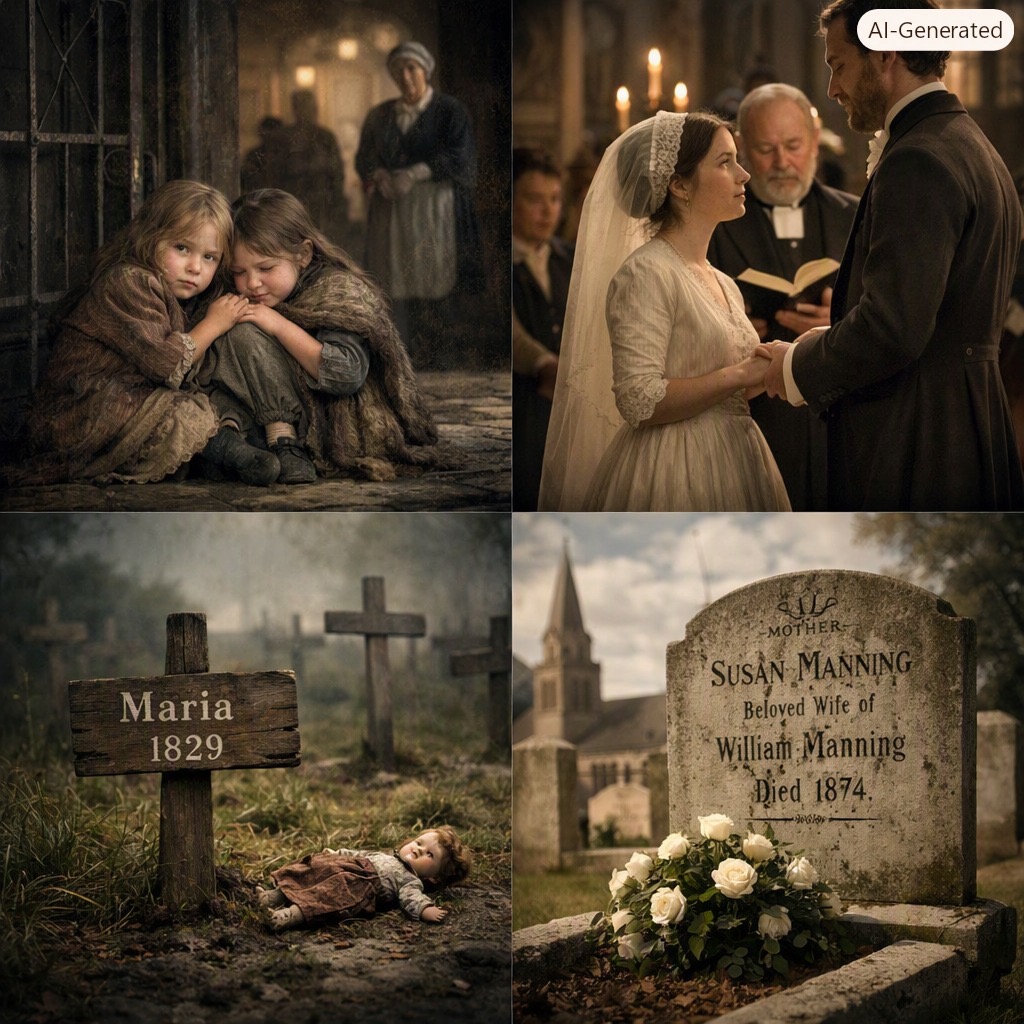
Susan grew up in Bawdsey in a hardworking but respectable family. Her father, a farm labourer, managed to keep them out of the workhouse, which was no small achievement in a region where poverty was ever present. At twenty‑seven, Susan left her village for the anonymity of a nearby town. It was there that she gave birth to twin girls, Maria and Elizabeth, both baptised as illegitimate.
A mother alone
Susan lived alone in the town and struggled to provide for her daughters. For four years she persevered. Then, in April 1828, the twins were found abandoned at the workhouse. At first, it is easy to imagine illness or desperation forcing her hand.
However, the records reveal a painful detail. Susan had married William Manning just five days earlier.
What became of the twins
The 1841 Census shows Susan living with William and their four children. Maria and Elizabeth are absent. Workhouse records confirm the truth. Maria died in 1829 and was buried in the pauper burial ground at Nacton. Elizabeth remained in the workhouse and disappears from the records after 1841. Her fate is unknown, lost to gaps in the registers and the silence of history.
A grave that hides a story
Susan and William were buried together at St Peter and St Paul’s Church in Felixstowe. Their grave is respectable and gives no hint of the daughters left behind. Standing there today, it is impossible not to wonder whether Susan ever thought of Maria and Elizabeth again.
Why this story matters
Stories like Susan’s remind us that history is rarely tidy. It is full of difficult decisions made under immense pressure. Through careful research using parish registers, workhouse records and census entries, we can resurrect lives that would otherwise be forgotten.
This story began with a simple workhouse entry that recorded two four‑year‑old girls admitted on 21 April 1828. From that single line, a narrative unfolded that revealed heartbreak, resilience and the complex realities of early nineteenth‑century womanhood.
As genealogists, we honour these individuals by telling their stories with care. Every record is a thread. Every discovery is a chance to restore dignity to those whom history overlooked.